
Niche Profitability Assessment Tool
How Profitable Is Your Blog Idea?
Answer these questions to see if your blog topic has strong profit potential. Based on the article, successful blogs solve urgent problems that people are willing to pay to fix.
If you're wondering what kind of blogs actually make real money-like enough to replace a full-time job-you're not alone. Thousands of people start blogs every day hoping to earn passive income. But most give up within six months because they picked the wrong niche. The truth? Not all blogs are created equal when it comes to profit. Some make $500 a month. Others make $50,000. The difference isn’t luck. It’s niche choice.
Profitable blogs solve urgent problems
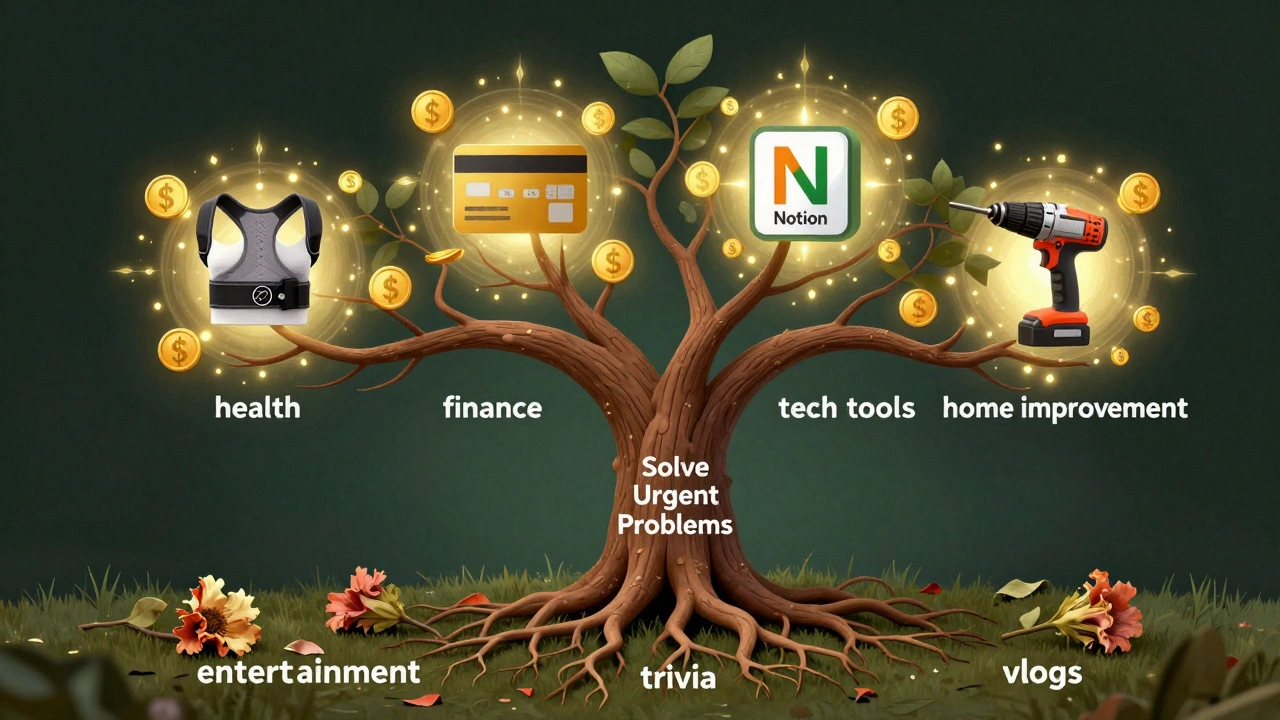
The most profitable blogs don’t just talk about hobbies. They fix real problems people are willing to pay to fix. Think about it: if someone’s struggling with chronic back pain, they’ll click on a blog post about home remedies. But if they’ve tried everything and still can’t sleep, they’ll buy a $299 posture corrector from a blog that recommends it. That’s the gap between traffic and income.
Look at blogs in the health and wellness space. A blog focused on ‘how to lose weight fast’ gets lots of views. But a blog about ‘how to reverse prediabetes with food’? That audience is desperate. They’ll buy meal plans, supplements, coaching programs. They’ll sign up for email lists. They’ll click affiliate links. That’s because their problem is urgent, personal, and expensive to solve.
Finance and investing blogs dominate earnings
If you want to know which niche consistently tops the charts for income, look at finance. Blogs about budgeting, side hustles, credit repair, and investing in index funds make serious money. Why? Because money is emotional. People are scared of debt. They want security. They’ll pay for tools, courses, and advice that helps them feel in control.
Take a blog like ‘The Financial Diet’ or ‘Mr. Money Mustache’. They don’t sell products. They build trust. Then they recommend tools like Personal Capital, Betterment, or credit cards with sign-up bonuses. Each referral can earn $50-$200. One post about ‘how to get a $500 bonus for opening a bank account’ can generate $10,000 in affiliate income if it ranks on Google.
And here’s the kicker: finance blogs have high-ticket offers. A $1,000 online course on tax optimization? People buy it. A $5,000 financial planning package? They pay upfront. That’s why finance blogs often rank #1 in earnings-not because they get the most traffic, but because each visitor is worth more.
Technology and software reviews pay well
Another high-earning niche? Tech tools. Not just gadgets. Think software reviews for professionals. A blog that tests and compares tools like Notion, ClickUp, or ConvertKit isn’t just writing reviews. It’s building a decision engine for businesses and solopreneurs.
These audiences don’t just want opinions. They want data. ‘Which project management tool saves the most time?’ ‘Can Jasper really write blog posts better than me?’ These questions drive traffic. And because these tools have affiliate programs with 30-50% recurring commissions, a single review can earn $1,000+ per month if it ranks.
For example, a blog post titled ‘Notion vs ClickUp in 2025: Which One Saves You 10 Hours a Week?’ gets 15,000 monthly views. If 2% of readers click the affiliate link and sign up for a $12/month plan, and the blogger gets 40% commission, that’s $1,440 per month-just from one post. And that post keeps earning for years.
Home improvement and DIY blogs are quietly profitable
You might not think fixing a leaky faucet makes you rich. But if you’ve ever searched ‘how to install a smart thermostat’ or ‘best cordless drill for beginners’, you’ve seen how many people are doing home projects themselves. That’s a goldmine.
Home improvement blogs earn through affiliate links to tools, materials, and online courses. A review of the top 5 cordless drills on Amazon? Each sale earns $15-$50. A guide on ‘how to tile a bathroom yourself’? That post can link to tile adhesive, grout, measuring tools, and safety gear. One well-optimized post can bring in $3,000 a month from Amazon Associates alone.
And here’s what most people miss: these blogs attract older audiences-people with disposable income. They’re not buying cheap stuff. They’re buying quality. They’re willing to spend $400 on a drill if it saves them $1,200 in labor. That’s the kind of buyer you want.
Education and online learning blogs are growing fast
With remote work and upskilling on the rise, blogs that teach skills are booming. Think ‘how to learn Excel for free’, ‘beginner’s guide to Google Analytics’, or ‘how to write resumes that get interviews’.
These blogs make money through digital products. An ebook on ‘10 Excel shortcuts that saved me 20 hours a week’ sells for $29. A $97 course on ‘how to land remote jobs without experience’? That’s a winner. One blog in this niche I tracked sold 800 copies of a $47 course in three months. That’s $37,600. No ads. No affiliates. Just a well-researched guide and a simple sales page.
What makes this niche powerful? The content has long shelf life. A tutorial on Excel doesn’t become outdated in six months. It stays relevant for years. That means your blog keeps earning while you sleep.
Why some blogs fail even with great content
Let’s be clear: great writing doesn’t pay the bills. A blog about ‘my yoga journey’ or ‘my cat’s daily life’ might get lots of likes on Instagram. But it won’t make money unless it connects to a product or service people will pay for.
Most failed blogs fall into one trap: they write for themselves, not for buyers. They pick niches because they like them-not because people are spending money in that space. You can love knitting. But unless you’re selling knitting patterns, yarn subscriptions, or tools, you’re not building a business.
Ask yourself: if someone found my blog today, would they want to buy something from me? If the answer is no, you’re writing for fun, not profit.
What to avoid: low-profit niches
Not every popular niche is profitable. Here are the ones that rarely pay:
- General news and current events-ad revenue is low, and content expires fast
- Entertainment recaps (TV shows, movies)-hard to monetize without ads
- Personal vlogs or lifestyle diaries-unless you have millions of followers
- Random trivia or fun facts-no clear path to sales
- Politics or religion-ad networks often ban them, and audiences rarely buy
These niches get traffic, but they don’t convert. You can’t sell a product to someone who just wants to be entertained. Profit needs intent.

How to pick your profitable niche
Here’s a simple test to find your high-earning niche:
- Write down 3 problems you’ve solved or helped others solve
- Search those problems on Google. Are people buying solutions? Look for affiliate links, paid courses, or product reviews in the top results
- Check Amazon. Are there best-selling books, tools, or kits related to this problem?
- Look at ClickBank or ShareASale. Are there high-commission offers in this space?
- If all four answers are yes-you’ve found your niche
For example: You helped a friend quit sugar. Search ‘how to quit sugar’-top results have meal plans, supplements, and coaching programs. Amazon has sugar-free cookbooks. ClickBank has a $67 sugar detox course with 60% commission. That’s your green light.
Real examples from 2025
Let’s look at three real blogs making $20k+ per month in early 2025:
- ‘The Frugal Home’-teaches how to cut household bills by 50%. Earns through affiliate links to energy monitors, smart thermostats, and bulk food suppliers. Makes $28,000/month.
- ‘Code for Beginners’-walks people through building their first website with WordPress. Sells a $149 video course and recommends hosting services. Makes $31,000/month.
- ‘Mental Health for Men’-covers therapy, mindfulness, and emotional resilience. Offers a $99 self-help journal and links to online counseling platforms. Makes $22,000/month.
Notice the pattern? Each blog targets a specific audience with a clear pain point. Each offers a product or service to solve it. None of them just post random thoughts.
Start small, think big
You don’t need to be an expert to start. You just need to be one step ahead of your reader. If you’ve fixed a problem, you can teach it. If you’ve saved money, you can show others how. Profitable blogs aren’t about being the smartest person in the room. They’re about being the one who shows up consistently with a solution people are ready to pay for.
Don’t chase trends. Chase problems. The money follows the pain.
Can I make money with a free blogging platform like WordPress.com or Blogger?
Yes, but it’s harder. Free platforms limit your ability to install plugins, customize design, or use affiliate links. Many block ads entirely. You also don’t own your domain, which hurts SEO. If you’re serious about profit, move to self-hosted WordPress.org. It costs under $5/month and gives you full control. Free platforms work for practice, not profit.
How long does it take for a blog to start making money?
Most bloggers see their first income between 6 and 12 months. It depends on how often you post, how well you optimize for search engines, and whether your niche has buying intent. Blogs in finance or tech can earn sooner because they rank faster and have higher-paying affiliates. A blog posting 2-3 times a week with solid SEO can hit $500/month by month 8. But if you post once a month and don’t optimize, you might wait 2 years-or never earn anything.
Do I need a huge audience to make money from my blog?
No. You need a small, targeted audience that trusts you. A blog with 5,000 monthly visitors in a high-value niche (like finance or software) can earn more than a blog with 100,000 visitors in a low-value niche (like celebrity gossip). One hundred readers who are ready to buy a $50 course? That’s $5,000. Ten thousand readers who just scroll? That’s $0. Focus on quality, not quantity.
What’s the easiest way to monetize a blog?
Start with affiliate marketing. Sign up for programs like Amazon Associates, ShareASale, or CJ Affiliate. Write honest reviews of tools or products you actually use. Link to them naturally in your posts. It takes no upfront cost, and you earn when people buy. Once you have traffic, add digital products like PDF guides or email courses. They have higher margins and you keep 100% of the profit.
Is it too late to start a profitable blog in 2025?
No. The internet keeps growing. New problems emerge every day. People still need help with taxes, mental health, home repairs, and learning new skills. The key isn’t being first-it’s being specific. Instead of ‘fitness blogs’, try ‘fitness for women over 40 with joint pain’. Instead of ‘travel blogs’, try ‘budget travel for solo dads’. The more specific you are, the less competition you face-and the more valuable you become to your readers.
Next steps: Pick your niche and start
Don’t wait for the perfect idea. Pick one problem you understand, write three posts about solving it, and publish. Don’t overthink. Don’t chase perfection. Just start. The first blog post you write won’t make money. But the tenth? The fiftieth? Those will. Profitable blogs aren’t built in a week. They’re built one honest, helpful post at a time.