Blog Post SEO Health Checker
Answer the following questions about your current draft to identify potential SEO pitfalls.
Audit Result
You spent three hours writing that perfect blog post. You polished the grammar, added some nice images, and hit publish with excitement. Then... nothing. Zero traffic. No comments. Just silence. It’s frustrating, right? But before you blame Google or your audience, look at what you actually posted. Often, the problem isn’t that you didn’t write enough; it’s that you wrote the wrong things.
Posting blindly without considering blog SEO is the practice of optimizing web content to rank higher in search engine results and attract organic traffic can hurt your site more than helping it. Search engines like Google are getting smarter every day. They don't just count keywords anymore; they evaluate quality, user experience, and trustworthiness. If your content triggers red flags for these algorithms, you’re fighting an uphill battle.
1. Thin Content Without Real Value
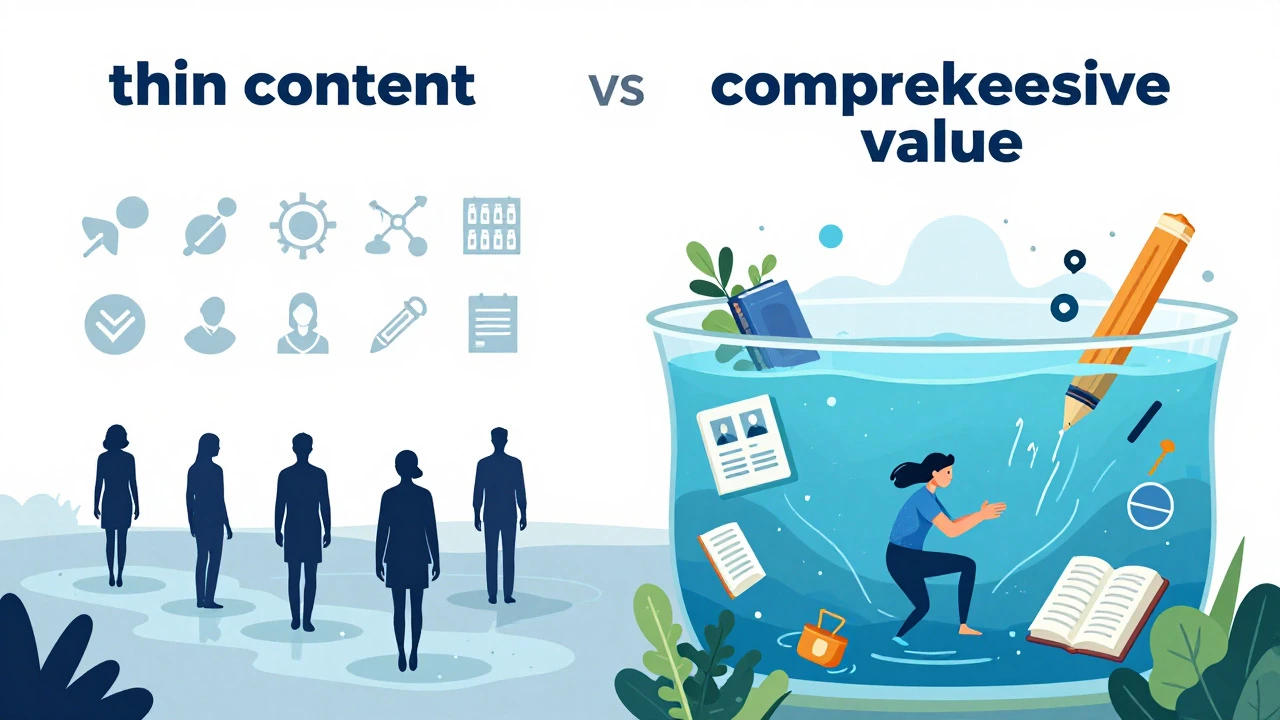
Let’s talk about "thin content." This is the biggest sin in modern blogging. Thin content refers to pages that have very little unique text, offer no real insight, or simply rehash information already available elsewhere. Think of those 300-word posts that answer a question vaguely or list five points without explaining them. Google has been cracking down on this since the Panda update years ago, but it’s still everywhere.
Why does this matter? Because users bounce immediately when they land on a page that doesn’t solve their problem. High bounce rates signal to search engines that your page is irrelevant. If you’re writing about "How to Make Coffee," don’t just say "Boil water and add beans." Give them ratios, bean types, grind sizes, and brewing times. Depth beats brevity when it comes to building authority. Aim for comprehensive guides rather than surface-level skims.
2. Keyword Stuffing and Unnatural Language
Back in the early 2000s, you could stuff a page with the word "best running shoes" fifty times and rank #1. Those days are dead. In fact, keyword stuffing now hurts you. When you force keywords into sentences where they don’t belong, you create awkward, robotic reading experiences. Readers notice, and so do algorithms.
Instead of repeating your main phrase over and over, focus on semantic relevance. Use synonyms, related terms, and natural variations. For example, if your target is "healthy breakfast ideas," also use phrases like "nutritious morning meals," "quick energy boosters," and "protein-rich starts." This approach satisfies both human readers who want smooth prose and search bots looking for topical depth. Read your draft aloud-if it sounds like a robot wrote it, rewrite it.
3. Outdated Information and Broken Links
One of the quickest ways to lose credibility is posting outdated facts. If you wrote a guide on "Tax Laws for Freelancers" in 2020 and haven’t touched it since, you’re likely misleading your readers today. Google prioritizes fresh, accurate content, especially for topics where timeliness matters (like tech, finance, or health). An article titled "Best Smartphones of 2024" sitting on your site in mid-2026 looks negligent.
Beyond accuracy, check your links. A single broken link can frustrate a reader, but dozens of them suggest a neglected website. Use tools to audit your old posts quarterly. Update statistics, refresh screenshots, and remove references to discontinued products. If a piece of content is fundamentally obsolete, consider archiving it or redirecting it to a newer, better resource. Freshness signals vitality to search engines.
4. Plagiarized or Duplicate Content
Copying content from other sites-even paraphrasing too closely-is a fast track to being de-indexed. Search engines crawl billions of pages daily. If they find your post matches another source word-for-word, they will likely ignore yours because it adds no new value. Worse, if the original site reports you, you could face penalties.
But it’s not just about stealing from others. Posting duplicate content on your own site is equally damaging. Have you ever published a guest post on another platform and then republished the exact same text on your blog? That creates internal competition. Your two pages fight each other for rankings, splitting your authority. Instead, write unique angles. If you’ve covered a topic before, link to it internally rather than rewriting it. Originality builds trust; duplication destroys it.
5. Ignoring User Experience (UX) and Mobile Optimization
You might have brilliant insights, but if your blog is impossible to read, nobody cares. This isn’t just about design aesthetics; it’s about technical usability. Large blocks of text without subheadings, tiny font sizes, and intrusive pop-ups drive readers away. More importantly, if your site isn’t mobile-friendly, you’re losing half your potential audience. Google uses mobile-first indexing, meaning it primarily looks at the mobile version of your site to determine rankings.
Ask yourself: Is my content scannable? Do I use short paragraphs, bullet points, and clear headings? Are images optimized so they load quickly on slower connections? A slow-loading page increases bounce rates dramatically. Compress your images, enable caching, and keep your layout clean. Good UX keeps people on your page longer, which boosts engagement metrics that search engines love.
6. Overly Promotional or Salesy Tone
Blogs are supposed to provide value first, sell second. If every paragraph ends with "Buy Now" or feels like a hard pitch, readers will tune out. People come to blogs to learn, be entertained, or solve problems-not to be sold to aggressively. When your content feels like an advertisement disguised as an article, it loses authenticity.
This affects SEO indirectly through engagement. Users spend less time on sales-heavy pages, leading to lower dwell time. Instead, adopt a helpful tone. Share personal experiences, case studies, or honest reviews. Build trust by giving away free advice generously. When you eventually mention a product, frame it as a solution to a problem you’ve already explained thoroughly. Soft selling works better because it respects the reader’s intelligence.
7. Neglecting Internal Linking Structure
Every blog post should exist within a connected ecosystem, not as an isolated island. Failing to link to your other relevant articles means you’re missing out on distributing page authority across your site. Internal linking helps search engines understand the structure of your content and keeps readers engaged by guiding them to deeper topics.
Think of your blog as a library. Would you leave books scattered on the floor, or would you organize them by genre and cross-reference similar titles? Similarly, link from new posts to older, foundational pieces. Use descriptive anchor text (e.g., "learn more about keyword research strategies") rather than generic clicks like "click here." This contextual signaling helps crawlers index your site more effectively and improves navigation for humans.
| Mistake | Why It Hurts SEO | Best Practice |
|---|---|---|
| Thin Content | High bounce rates, low authority | Write comprehensive, in-depth guides |
| Keyword Stuffing | Penalized by algorithms, poor readability | Use natural language and semantic variations |
| Outdated Info | Loses trust, ranks poorly for freshness | Update regularly, archive obsolete posts |
| Duplicate Content | Confuses crawlers, splits ranking power | Create unique perspectives, use canonical tags |
| Poor Mobile UX | Mobile-first indexing penalty | Optimize for speed, readability, and touch interfaces |

8. Ignoring Search Intent
This is perhaps the most subtle yet critical error. You might have great content, but if it doesn’t match what the user is actually looking for, it won’t rank. Search intent falls into four categories: informational (wanting to learn), navigational (looking for a specific site), commercial (researching before buying), and transactional (ready to buy).
If someone searches for "best laptop for students," they want comparisons and recommendations (commercial intent). If you post a technical deep-dive on CPU architecture (informational intent), you’ll miss the mark. Analyze the top-ranking pages for your target keywords. What format do they use? Lists? Guides? Reviews? Mirror that intent. Satisfying the searcher’s goal is the ultimate SEO strategy.
9. Using Low-Quality or Irrelevant Images
Images break up text and make content visually appealing, but using generic stock photos or unoptimized files can backfire. Blurry images look unprofessional. Huge file sizes slow down your page speed, which is a direct ranking factor. And if the image has nothing to do with the topic, it confuses the context.
Always compress images before uploading. Use tools like TinyPNG or ShortPixel to reduce file size without losing quality. Add descriptive alt text to help screen readers and search engines understand the image content. Better yet, use original screenshots, diagrams, or custom graphics. Unique visuals increase shareability and brand recognition, setting you apart from competitors relying on cliché stock photography.
10. Forgetting a Clear Call-to-Action (CTA)
Finally, don’t leave your readers hanging. Every blog post should guide the user toward the next step. Whether it’s subscribing to your newsletter, leaving a comment, or checking out a related product, a clear CTA turns passive readers into active participants. Without direction, users often just close the tab after finishing the article.
Place CTAs naturally within the flow of your content. Don’t interrupt the reading experience with aggressive banners. Instead, offer logical next steps based on the content provided. For example, after a tutorial on email marketing, invite readers to download your free checklist. Engagement signals-like comments and shares-tell search engines that your content resonates, boosting its visibility over time.
What is the biggest mistake bloggers make regarding SEO?
The biggest mistake is ignoring search intent. Writing great content that doesn't answer the specific question the user typed into Google leads to high bounce rates and low rankings. Always analyze top-ranking pages to understand what format and angle satisfy the query best.
Does thin content really hurt my blog's ranking?
Yes, significantly. Thin content provides little value to users, causing them to leave quickly. Search engines interpret this as poor quality, lowering your domain authority over time. Aim for comprehensive, well-researched articles that fully address the topic.
How often should I update old blog posts?
Ideally, review all posts annually. For topics involving technology, finance, or health, check them every six months. Update statistics, fix broken links, and add new insights to keep the content fresh and relevant for both users and search algorithms.
Is keyword stuffing still a thing in 2026?
No, keyword stuffing is harmful. Modern algorithms prioritize natural language processing and semantic relevance. Focus on writing for humans first, using keywords naturally within context. Forced repetition can trigger spam filters and degrade user experience.
Can duplicate content on my own site hurt my SEO?
Yes, it causes cannibalization where multiple pages compete for the same keywords, diluting your ranking power. Use canonical tags to point to the preferred version, or merge similar posts into one definitive guide to consolidate authority.