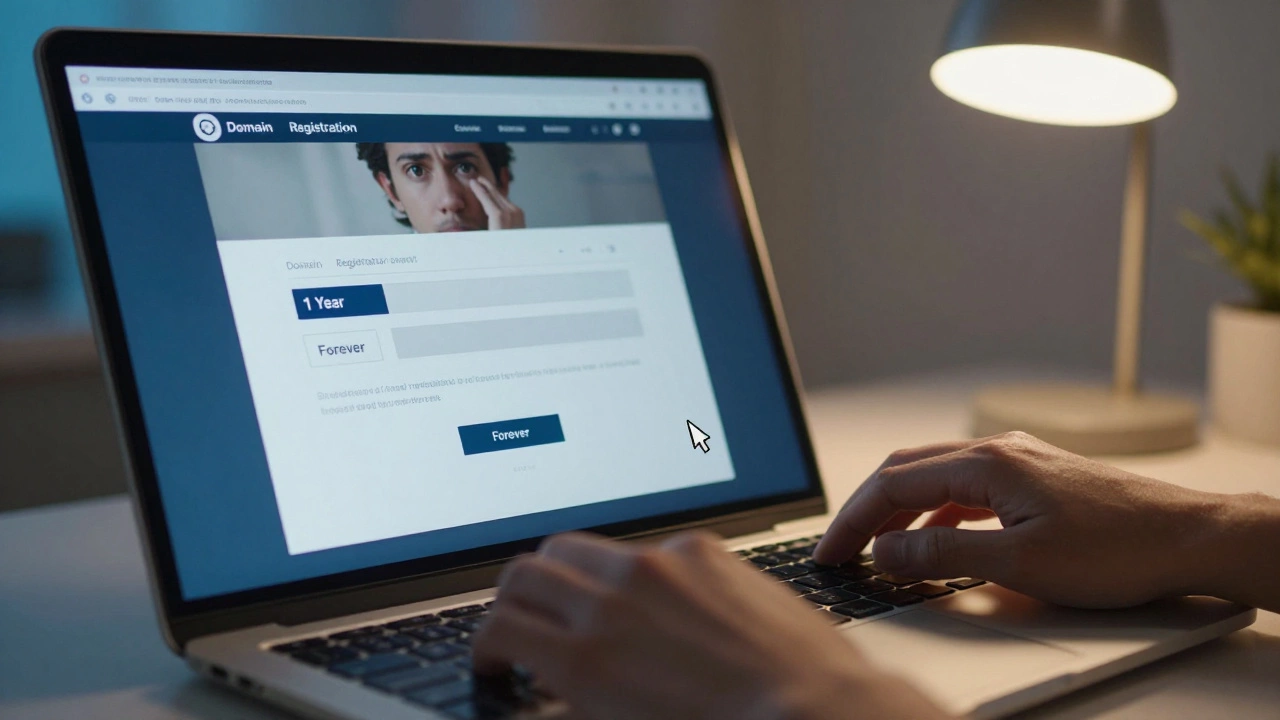
Domain Expiration Lifecycle Simulator
Grace Period (0-45 Days)
Your site is still live.
Renewal Cost: Standard Price (~$10-15)
Redemption Grace Period (46-75 Days)
Site is offline. Recovery is expensive.
Renewal Cost: High Fee (~$80-$150 + Renewal)
Pending Delete (76-80 Days)
No recovery possible. Domain is marked for destruction.
Cost: N/A (Unrecoverable)
Available / Dropped (81+ Days)
Domain is open for public registration.
Risk: High chance of being snatched by bots/squatters instantly.
You want to secure your brand online. You find the perfect name. You check your bank balance, ready to pay once and forget about it forever. But when you click "Buy," the checkout page asks for one year. Then another. There is no button that says "Pay Once, Own Forever."
This confusion stops many people from launching their sites. It feels like a scam or a hidden fee trap. The short answer is simple: you cannot buy a domain name permanently. Not today. Not ever.
Domain names are not real estate. You do not own the land; you rent the address. This article explains why this system exists, how long you can actually lock in your name, and what happens if you stop paying. We will also look at how this works specifically for users in India, where local registrars and regulations add another layer to the process.
The Reality of Domain Ownership
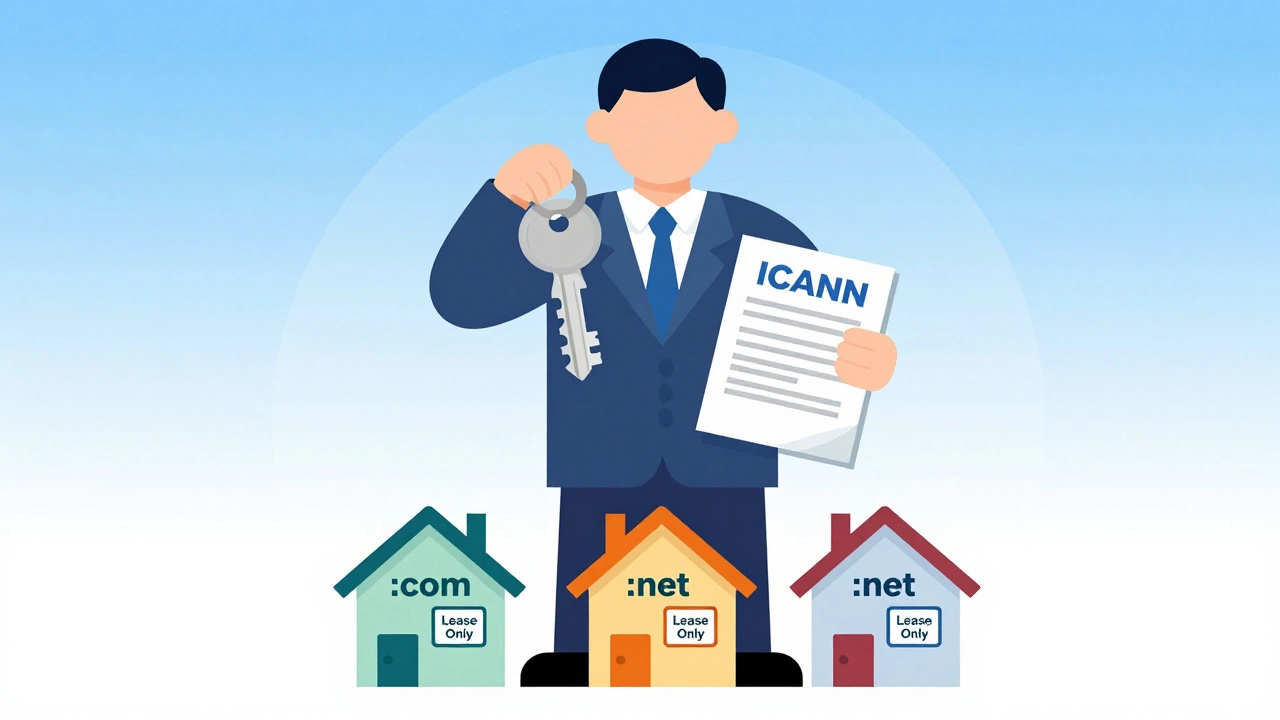
To understand why permanent purchase is impossible, we have to look at who controls the internet's phone book. That role belongs to ICANN, which stands for the Internet Corporation for Assigned Names and Numbers. ICANN is a non-profit organization that coordinates the Domain Name System (DNS) globally.
Think of ICANN as the landlord of the entire internet. They do not sell the houses (the domains); they issue leases. When you register a domain, you are signing a contract with a registrar-like GoDaddy, Namecheap, or an Indian provider like BigRock-to hold that lease on your behalf.
Why does it work this way? If someone bought a domain permanently in 1995, they could sit on it forever without using it. This would lead to massive hoarding. By requiring annual renewals, ICANN ensures that unused names eventually drop back into the public pool. This keeps the internet dynamic and prevents a small group of people from monopolizing common words.
How Long Can You Actually Register?
While you cannot buy forever, you can buy for a long time. Most registrars allow you to register a domain for up to 10 years at a time. This is the maximum limit set by ICANN policies.
Here is how the timeline usually looks:
- Minimum Term: 1 year. This is the standard starting point.
- Maximum Term: 10 years. You can prepay for a decade to avoid worrying about expiration for a while.
- Renewal: After 10 years, you must renew for another block of time.
For most personal blogs or small businesses, registering for two to three years is a sweet spot. It gives you enough time to build the site without a huge upfront cost. If you are building a major brand, locking it in for ten years makes sense. It protects you from accidental expirations during busy periods.
What Happens If You Stop Paying?
This is the part that scares people. What if you forget to renew? Do you lose everything instantly? No. The system has built-in safety nets, but they come with costs.
When your domain expires, it does not vanish immediately. It goes through a specific lifecycle managed by the registry:
- Grace Period (0-45 days): Your domain still works. You can renew it at the normal price. Most registrars send emails reminding you to pay.
- Redemption Grace Period (30 days): If you missed the first window, the domain enters redemption. It is taken offline. To get it back, you must pay a hefty redemption fee, often $80-$150 USD on top of the renewal cost.
- Pending Delete (5 days): The domain is marked for deletion. No one can renew it here. It is waiting to be released.
- Available: The domain drops back into the open market. Anyone can register it. This is when domain investors, known as squatters, use bots to snatch valuable names the second they become available.
If you let your domain go to "Pending Delete," you likely lose it forever unless you are willing to pay thousands of dollars to buy it back from whoever grabbed it next.
Buying Domains in India: Local Context
If you are based in India, the process is similar, but there are local nuances. You can buy global domains like .com, .net, and .org from international registrars, or you can choose country-code top-level domains (ccTLDs) like .in.
The .in domain extension is managed by NIXI (National Internet Exchange of India). For .in domains, the rules are slightly different regarding eligibility. Historically, you needed proof of presence in India to register a .in domain. However, recent changes have made it easier for anyone to register these names, though some specific sub-domains (like .co.in or .firm.in) may still require documentation.
When buying in India, consider these factors:
- Currency Fluctuations: Most domain prices are set in USD. If the Rupee weakens, your renewal cost in INR goes up. Locking in a longer term helps hedge against this.
- GST: Remember that Goods and Services Tax (GST) applies to digital services in India. The price you see at checkout might increase by 18% after tax is added.
- Local Support: Indian registrars like HostGator India, Bluehost India, or BigRock offer support in local time zones. This can be crucial if you need help during a technical issue.
Comparison: Global vs. Indian Registrars
| Feature | International Registrars (e.g., Namecheap) | Indian Registrars (e.g., BigRock) |
|---|---|---|
| Pricing Transparency | Often lower initial prices, higher renewal fees | Competitive pricing, clear GST breakdown |
| Currency | USD (fluctuates with exchange rates) | INR (stable for local users) |
| Support Timezone | US/Europe centric | IST (Indian Standard Time) |
| Payment Methods | Credit Cards, PayPal | UPI, Net Banking, Credit Cards |
| Privacy Protection | Often free for life | Sometimes charged separately |
Protecting Your Investment
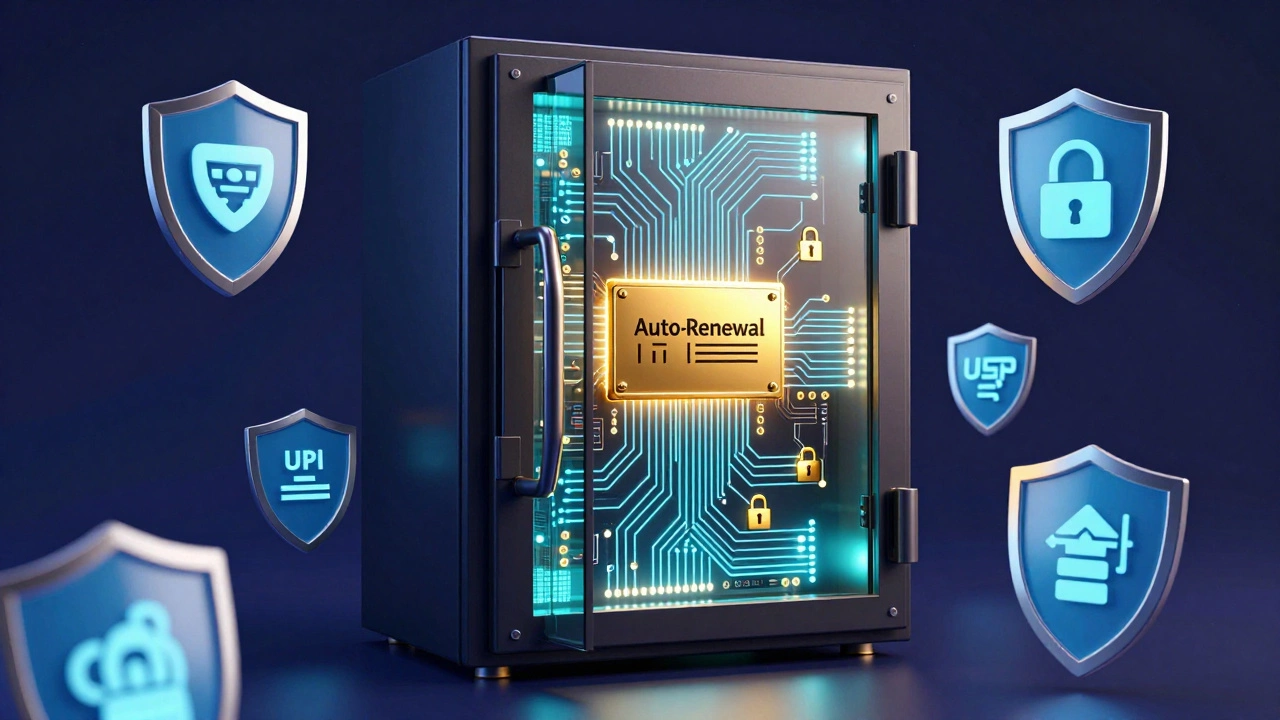
Since you are renting, your biggest risk is losing access. Here is how to protect your domain like it was property.
Enable Auto-Renewal
This is the single most important step. Turn on auto-renewal in your registrar account. Link a credit card or UPI method that stays active. Yes, you will be charged automatically. But the cost of losing your brand identity is far higher than the annual fee.
Use Domain Privacy
When you register a domain, your personal contact info (name, address, phone) is publicly visible in the WHOIS database. Spammers and scammers scrape this data. Most registrars offer "WHOIS Privacy" or "Domain Privacy." This replaces your details with generic proxy information. Many international registrars include this for free. In India, some providers charge extra for this service. It is worth every rupee.
Lock Your Domain
Enable "Registrar Lock" or "Transfer Lock." This prevents anyone from transferring your domain to another company without your explicit permission. It stops hackers who might compromise your email account from stealing your domain.
Common Myths Debunked
Myth 1: I can buy a domain for 100 years.
False. ICANN caps registrations at 10 years. Any website claiming to sell 100-year registrations is either misleading you or selling a separate legal agreement that does not override ICANN rules.
Myth 2: If I build a website on it, I own it.
False. Building content on a domain does not grant ownership. If you stop paying the registration fee, the domain expires regardless of how much traffic your site gets.
Myth 3: Trademarking a name lets me keep it forever.
Partially true. A trademark protects your brand legally, but it does not replace domain registration. You still need to pay the registrar. However, if someone else steals your expired domain, a trademark gives you legal grounds to demand it back through ICANN’s Uniform Domain-Name Dispute-Resolution Policy (UDRP).
Final Thoughts on Domain Strategy
You cannot buy a domain permanently, but you can manage it securely for decades. Treat your domain like a utility bill. It is a recurring cost of doing business online. Budget for it annually. Set up auto-pay. Enable privacy. And never let it expire.
For users in India, choosing a registrar that offers easy payment methods like UPI and clear GST invoices can simplify your accounting. Whether you choose a global giant or a local provider, the core rule remains the same: consistency is key. As long as you keep the lease paid, your digital address is yours to command.
Is it possible to buy a domain name for life?
No, it is not possible to buy a domain name for life. ICANN regulations limit domain registrations to a maximum of 10 years at a time. You must renew the domain periodically to maintain control over it.
What happens if I forget to renew my domain?
If you forget to renew, your domain enters a grace period (usually 30-45 days) where you can still renew it at the normal price. After that, it moves to a redemption period with high fees. Finally, it is deleted and becomes available for anyone to register.
Can I register a .in domain from outside India?
Yes, generally anyone can register a .in domain. While there used to be strict residency requirements, NIXI has relaxed these rules for generic .in domains. However, specific sub-domains like .co.in may still require proof of incorporation in India.
Why do domain prices increase after the first year?
Many registrars offer a low "introductory price" for the first year to attract customers. The renewal rate is the standard market price. Always check the renewal price before buying, not just the initial cost.
Does WHOIS privacy hide my ownership?
WHOIS privacy hides your personal contact details from the public database, protecting you from spam and scams. However, you remain the legal registrant of the domain in the background. ICANN can still access your details if required by law.
How much does it cost to renew a domain in India?
A standard .com domain typically costs between $10 to $15 USD per year. In India, this translates to roughly ₹800 to ₹1,300 INR, plus 18% GST. Prices vary depending on the registrar and any promotional offers.