Website Cost Calculator
Estimate Your Website Costs
Get a realistic estimate of what your website might cost based on your requirements. Remember: The cheapest option isn't always the best long-term investment.
Estimated Cost Range
This estimate includes basic design, development, and setup. Additional costs may apply for:
- Logo design
- Domain registration ($10-$20/year)
- Hosting ($5-$15/month)
- Extra revisions or updates
- SEO setup beyond basics
Remember: The cheapest option isn't always the best long-term investment. A poorly built site can cost you sales and reputation.
Want to know how much it really costs to get a website built? You’re not alone. People ask this all the time - and the answer isn’t a single number. It’s a range that swings from a few hundred dollars to tens of thousands, depending on what you actually need. If you’re expecting a flat fee like $500 for a full website, you’re setting yourself up for disappointment. If you think you’ll pay $10,000 for a simple brochure site, you might be overpaying. Let’s cut through the noise and give you real numbers based on what’s happening in 2025.
What kind of website are you building?
The biggest factor in price isn’t who builds it - it’s what you’re asking them to build. There are three main types of websites, and each has a very different price tag.
Basic brochure site - this is just a few pages: Home, About, Services, Contact. No shopping cart, no login, no complex features. Just clean design and clear info. For this, you’re looking at $1,500 to $4,000. A freelancer in Sydney might charge $2,500. A small agency might charge $3,800. Anything under $1,200? Be careful. You’re likely getting a template with a few text changes, not a custom design.
Business website with functionality - this includes things like contact forms, appointment booking, image galleries, or a simple blog. Maybe a basic membership area or newsletter signup. This is what most small businesses need. Price range? $5,000 to $12,000. If you’re adding a simple online booking system (like Calendly integrated into WordPress), expect to pay closer to $7,000. If you need custom forms that save data to a database, it’ll hit $9,000 or more.
E-commerce or complex web app - this is where things get expensive. Online store with products, cart, payments, inventory, user accounts, shipping rules, tax calculations. Or a membership site with tiers, content gating, subscriptions. Or a tool like a booking system for therapists or a dashboard for clients. These projects start at $15,000 and can easily go to $50,000+. A Shopify store with 50 products and basic customizations? $18,000. A custom-built WooCommerce site with complex product variations and multi-vendor features? $35,000+. Don’t be fooled by agencies that promise “full e-commerce for $8,000.” That’s either a template with a few tweaks or a project that will need constant fixing later.
Do you need a freelancer or an agency?
Freelancers are cheaper. Agencies are more reliable. Neither is “better.” It’s about what you need.
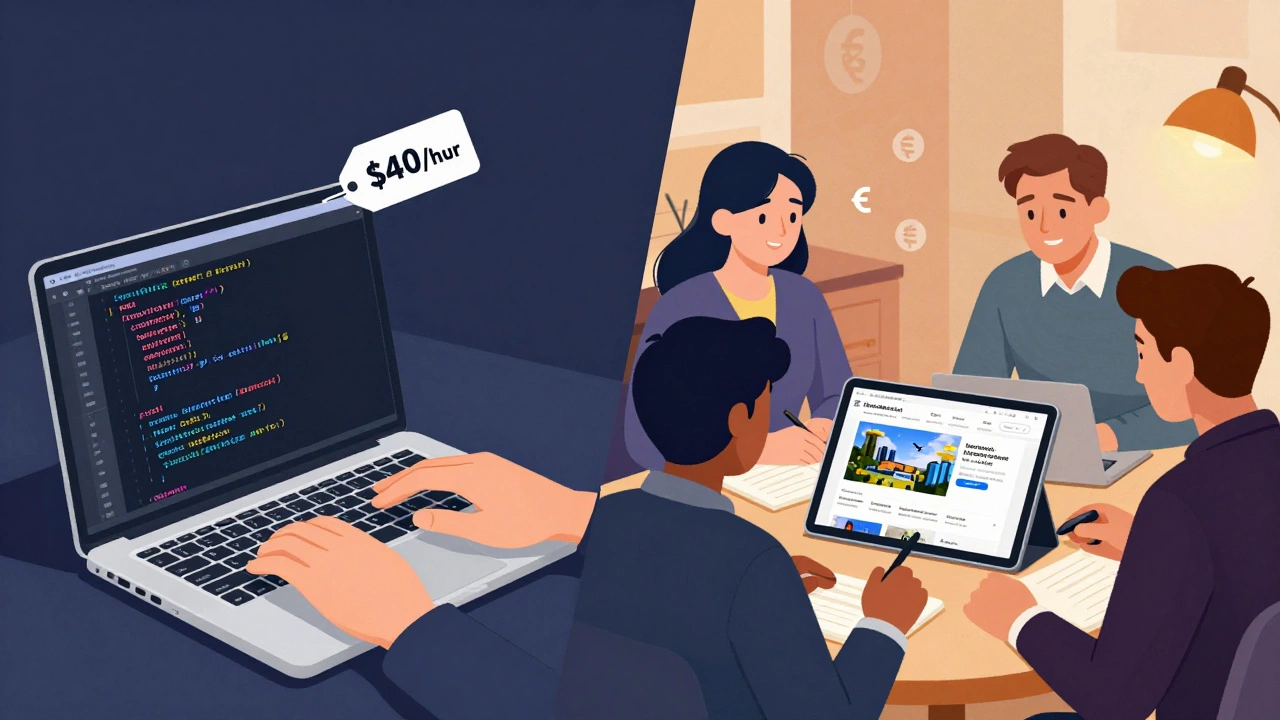
A freelance web developer in Australia might charge $40 to $80 an hour. For a basic site, that’s 30 to 50 hours - so $1,200 to $4,000 total. They’ll likely use WordPress or Webflow. They’re great if you have a clear idea of what you want and can give feedback quickly. But if you don’t know what you need, or if you’re not available to respond to questions, things will drag. And if something breaks six months later? You might not even be able to find them.
An agency charges $100 to $180 an hour. For the same basic site, you’re looking at $6,000 to $10,000. Why? Because you’re not just getting one person. You’re getting a designer, a developer, a project manager, and sometimes a QA tester. They handle deadlines, revisions, and post-launch support. Most agencies offer 30 to 90 days of free fixes after launch. That’s worth something.
Here’s a real example: A local gym in Bondi hired a freelancer for $2,800. The site looked fine at first. Three months later, the contact form stopped working. The freelancer disappeared. The gym spent another $1,500 to fix it with a new developer. That’s $4,300 total. They could’ve paid $5,500 upfront to an agency and had it handled for a year.
What’s included in the price?
Many people get shocked when they find out what’s not included. Here’s what you should expect to pay for - and what you’ll likely pay extra for.
- Included: Website design, basic SEO setup (title tags, meta descriptions), mobile responsiveness, 1-2 rounds of revisions, hosting setup instructions, basic training on how to update content.
- Not included (extra cost): Logo design, copywriting, stock photos, custom illustrations, SEO content writing, ongoing maintenance, domain registration, SSL certificate (usually free now, but sometimes charged), email setup, Google Analytics implementation, social media integration beyond a link.
Some agencies bundle copywriting for $1,200 extra. Others charge $75 per page for professional content. If you want your site to rank on Google, you need good writing. Don’t skip it. A poorly written site won’t convert, no matter how pretty it looks.
Also, watch out for “free hosting” offers. Most freelancers will point you to a cheap shared host like SiteGround or Hostinger. That’s fine. But if they say “we’ll host it for you for $20/month,” you’re being upsold. You can manage that yourself for under $10/month.
Platforms matter - and they affect cost
You’re not just hiring a person. You’re choosing a platform. Each has different costs and capabilities.
- WordPress - the most popular. Flexible, affordable. Costs $3,000 to $10,000 for a custom build. You own your site. Easy to update. Plugins can add functionality, but too many slow it down. Best for blogs, small businesses, portfolios.
- Webflow - visual builder. No coding needed. Great for designers. Costs $4,000 to $12,000. More control over design than WordPress. But harder to edit later if you’re not tech-savvy. Best for creative agencies, portfolios, landing pages.
- Shopify - built for stores. Costs $5,000 to $20,000. Monthly fees start at $29. You don’t manage hosting or security. But you’re locked into their system. Best for e-commerce with 10+ products.
- Custom code (HTML/CSS/JS) - rare. Only for unique apps. Costs $20,000+. You own everything, but maintenance is expensive. Best for startups with a specific tool or app.
Most small businesses should stick with WordPress or Shopify. They’re proven, supported, and have a huge pool of developers who can fix things later.
Hidden costs people forget
Here’s what catches people off guard:
- Domain name - $10 to $20 per year. Don’t let someone charge you $100 for this. You can buy it yourself at Namecheap or Google Domains.
- SSL certificate - free with most hosts now. If someone charges you for this, they’re not up to date.
- Content migration - if you have an old site and want to move your blog posts or products, that’s extra. $500 to $2,000 depending on volume.
- Training - if you want someone to sit with you for an hour to show you how to update text or add a photo, that’s often $150 extra.
- Post-launch fixes - if something breaks after the warranty period (usually 30 days), you pay hourly. $75 to $150/hour.
One client in Melbourne thought they paid $6,000 for their website. Later, they found out they also paid $1,200 for copywriting, $800 for photos, $400 for SEO setup, and $300 for domain and hosting. Total: $9,000. They didn’t realize those were separate line items.
How to avoid getting ripped off
Here’s how to protect yourself:
- Ask for a written proposal with a breakdown. No vague “starting at $5,000.” They should list: design hours, development hours, revisions, extras.
- Check their portfolio. Look for real websites they’ve built. Not just templates. Can you find the site online? Does it load fast? Is the code clean? Use Chrome’s View Source to check if it’s WordPress or a custom mess.
- Ask about post-launch support. What’s covered? For how long? Is there a maintenance plan?
- Don’t pay 100% upfront. 30-50% deposit, 30-40% on draft, 20-30% on launch. Standard practice.
- Read reviews on Google and Upwork. Look for patterns. Are people complaining about delays? Poor communication? Hidden fees?
If someone won’t give you a contract, walk away. A contract isn’t just paperwork - it’s proof you’re dealing with a professional.
What does a good website cost in 2025?
Here’s a quick cheat sheet:
| Website Type | Cost Range | Best For |
|---|---|---|
| Basic Brochure Site | $1,500 - $4,000 | Local services, freelancers, small businesses |
| Business Site with Features | $5,000 - $12,000 | Consultants, clinics, schools, e-newsletter sites |
| Simple E-commerce (Shopify) | $8,000 - $18,000 | 10-50 products, basic checkout |
| Complex E-commerce or App | $20,000 - $50,000+ | Subscription models, custom tools, marketplaces |
Remember: the cheapest option isn’t always the cheapest in the long run. A poorly built site costs you sales, reputation, and time. A good site? It works while you sleep.
Can you build it yourself?
Yes - but only if you have time and patience. Tools like Wix, Squarespace, and Shopify let you build a site in a weekend. But if you want to stand out, you need design sense, SEO knowledge, and content strategy. Most people who try DIY end up with a site that looks like everyone else’s - and doesn’t convert.
If you’re a solopreneur with a tight budget, start with Shopify or WordPress + a premium theme ($60-$100). Hire a copywriter for your homepage ($300). That’s $900 total. You can grow from there.
But if you’re serious about your business - and you want to attract customers, not just have a website - hire a pro. It’s not an expense. It’s an investment.
How much does a basic website cost in Australia?
A basic brochure website with 5-6 pages, mobile-friendly design, and a contact form typically costs between $1,500 and $4,000 in Australia. This includes design, setup, and basic SEO. Freelancers often charge on the lower end; agencies charge more for reliability and support.
Is it cheaper to use a website builder like Wix or hire a developer?
Wix, Squarespace, and Shopify are cheaper upfront - you can build a site for under $500 including themes and domains. But if you want your site to look professional, rank on Google, or handle complex features like booking or payments, hiring a developer gives you more control, better performance, and scalability. DIY works for simple sites; professional help is better for growth.
What’s the average hourly rate for a web developer in Sydney?
In Sydney, freelance web developers charge $40-$80 per hour. Agencies charge $100-$180 per hour. The rate depends on experience, the platform used (WordPress, Webflow, etc.), and whether they handle design, development, and SEO. Always ask for an estimated total hours, not just an hourly rate.
Do I need to pay for hosting and domain separately?
Yes. Domain names cost $10-$20 per year. Hosting starts at $5-$15 per month for basic plans. Some developers include setup but not ongoing fees. You should own your domain and hosting account - don’t let someone else control it. You can buy both yourself through providers like Namecheap or Hostinger.
How long does it take to build a website?
A basic website takes 2-4 weeks. A site with custom features or e-commerce takes 6-12 weeks. Delays usually happen because of slow feedback from the client. To speed things up, have your content, images, and brand guidelines ready before you start.
Should I choose WordPress or Shopify for my business website?
Choose WordPress if you want flexibility, control, and plan to add a blog or multiple features later. Choose Shopify if you’re focused on selling products online and want built-in security, payments, and easy scaling. WordPress is better for content-heavy sites; Shopify is better for stores.